

Trauma-Sensitive Yoga in Hopedale, Massachusetts
Yoga and somatic movement to help you reconnect with your body, on your terms.
Class Details
When: Friday, November 20, 2026
6:00-7:00pm
Where: 25 Dutcher St, Hopedale, MA
At Small Town Athletic Center, located in the lower level of the Union Evangelical Church.
Investment: $25.00*
Preregistration is required.
* $5 from every registration benefits Foster Care Essentials.
Your body is wise.
It has built-in defenses that automatically move you into fight, flight, freeze, or fawn when it detects a threat.
Your body may flee and get away. It may fight back. It may fawn, appeasing someone who is hard to leave. Or it may freeze, even collapse into shutdown, if that is what it takes to survive.
An experience becomes traumatic when your instinctive survival response is overridden. When there is nothing you can do to avoid the inevitable. Your body gets stuck in one of these defenses, and safety and ease stay out of reach.
Even once the threat has passed, your body stays ready for action.
Who this class is for
This space is for the body that learned to brace. Maybe you carry complex trauma or PTSD and have spent years on high alert, scanning every room. Maybe burnout has you running on willpower with your jaw tight and shoulders near your ears. Maybe you are healing from sexual trauma or birth trauma, and your body feels like a place things happened to. Maybe studio classes never felt quite right, like you were falling behind and stressed by the pressure to get it right. Or maybe you want a body-based companion to therapy. You do not need a diagnosis, a story to share, or any yoga experience at all. Come as you are, deep feelers and over-thinkers alike.
Why the body belongs in healing
Talking can help. And for many survivors, it is only part of the picture. The body needs its own experiences: sensation you can tolerate, movement you choose, small moments of action that let a defense response finish what it started.
Trauma-sensitive yoga offers those experiences, slowly and with plenty of room. You practice noticing. You get curious. You observe. Over time, that builds an inner sense of mastery, a felt sense of “I can be with this.” It brings new resources, new energy, and the capacity to take effective action.

What a class feels like
Trauma-sensitive yoga looks different from the class you might take at a studio. Your practice does not need to look a certain way. In fact, there is nothing you need to perfect or achieve here. The postures are a framework for finding any connection to your body that feels accessible today.
You will hear invitations, never commands. If you like. Maybe you could try. See what happens if.
Try something. If it doesn’t work, try something else. Every choice you make with your body is celebrated here.
There is no pressure.
Four threads run through every class:
Present moment. A slower pace, with time to feel your feet on the floor.
Choice. Everything is an experiment, and you hold the controls.
Effective action. Noticing what is uncomfortable and finding one thing you can do to help yourself feel better, safer, more comfortable, or in control.
Rhythm. Breath, movement, and countdowns that give you a clear beginning and a clear end.
What is somatic movement?
Somatic movement is slow, exploratory movement where your attention stays on how it feels from the inside. “Soma” is the Greek word for the living body, and the term points to the body as you experience it, things like sensation, tension, breath, balance, and impulse.
The idea is that much of our tension is learned. Habit, stress, injury, and old protective patterns teach the body to hold itself a certain way, often without us noticing. Small, slow, attentive movement gives the brain new information, so it can loosen what it was holding and find more options.
It’s not just about moving through the practice on autopilot or to say you did it. When we incorporate somatics, we intentionally weave in moments to turn our attention inward, to notice how the practice feels in your body.
As always, it’s simply an invitation. If being with your internal world feels like too much, you’re welcome to simply keep your attention focused externally, on the world around you, or somewhere that feels safe and steady to you. Your comfort and safety are the priority. You always have choice in this practice, and there are plenty reminders of that.
Meet your teacher
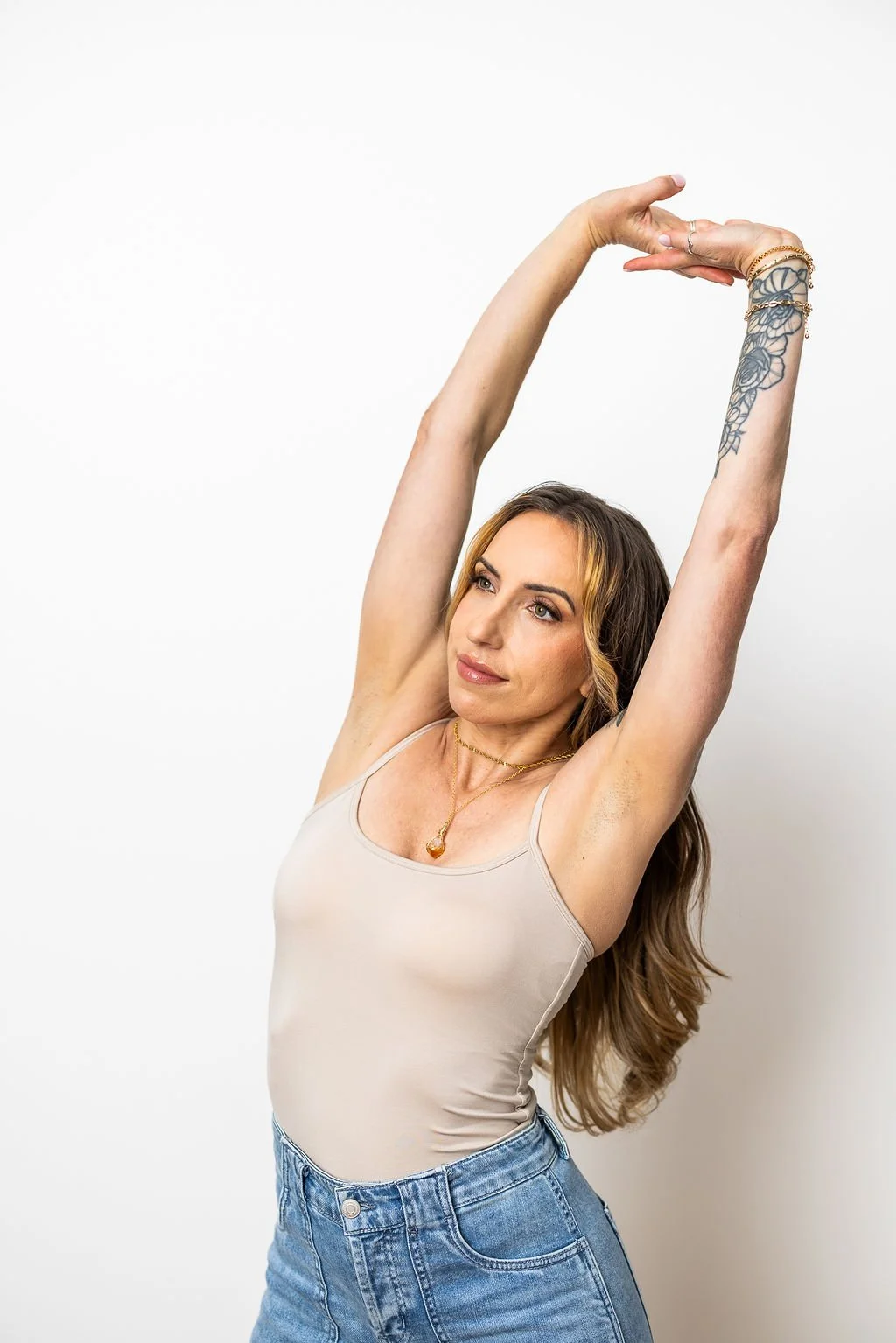
Nearly a decade ago I entered my first Yoga Teacher Training with the intention of bringing what I learned back into the mental health space. I have always been less interested in receiving teachings from a ‘guru’ stationed up on a platform and much more intrigued through learning the wisdom of my own body.
Initially, I found my way onto the mat through more rigorous, strength based practices that matched the fight/flight energy my body was swimming in. Over time, however, my body learned to experience safety in stillness, in slower, more instinctive practices rather than regimented flows designed to look the same for every body in the room. Supporting others to honor their own rhythms, find safety, and discover a new sense of agency lights me up. I look forward to sharing this space with you!
Frequently Asked Questions
-
None. Every posture comes with options. Beginners, longtime practitioners, and everyone in between belongs here.
-
No. You never have to talk about what happened to you, in class or afterward. The practice happens in your body, on your terms. Getting started is simple. Reach out through our contact form or schedule a call—we’ll walk you through the next steps and answer any questions along the way.
-
If something feels like too much, you can always stop. You can also explore making the movement smaller, or slower. You can open your eyes and look around. Sip some water. Step out if you want to. You always have choice here, and nobody will ask you to explain.
-
No, this is not a replacement for therapy. It is a movement class. Many people find it a good companion to therapy, and you do not need to be in therapy to attend. If you’d like to explore therapy, I’d be happy to hear from you.
-
No. While my therapy practice is open to women and female-embodied individuals, trauma-sensitive yoga classes are open to anyone ages 18 and up.
-
Clothes you can move in comfortably. Please arrive with your own mats and water. Props like blocks, blankets, or bolsters are not necessary, but you are welcome to bring if you would like.
-
Trauma-Sensitive Yoga does not involve any hands-on assists or adjustments.
-
You’ll be taken to a payment page. Payment confirms your place in class.
-
I’ll email you, typically within 1 business day, with class details and a link to the required New Student Registration form. Please complete it before you arrive for class. If you don’t see my email, check your spam folder or reach out at amywilliams@feltsense.co.
-
The class will take place at 25 Dutcher St, Hopedale, MA 01747, the home of Small Town Athletic Center, in the lower level of the Union Evangelical Church (UCC). Park in the parking lot and enter through the backdoor. Walk down two short flights of stairs and through the door on your left at the bottom.
-
Because space in each class is limited, registrations are non-refundable. If something comes up and you can’t make it, please let me know. You’re welcome to transfer your spot to a friend, or apply it to a future class. If you transfer your spot, please have your friend reach out to me so they can complete the required New Student Registration form before class.
What Students Have Said —