
Somatic Therapy vs. Talk Therapy: What’s the Difference and How Do You Know What You Need?
You may already understand your patterns, your history, and where your struggles began- yet your body still reacts as if the threat hasn’t passed. Many people reach this point after years of therapy, wondering why insight alone hasn’t brought the change they hoped for. This isn’t a personal failure. It often signals the need for an approach that works not only with the mind, but with the nervous system and the body. Traditional talk therapies and somatic therapies serve different purposes, and each can be supportive depending on what your nervous system needs.
What People Mean by “Talk Therapy”
Traditional talk therapies focus on thoughts, emotions, and insight through conversation. These approaches are considered top-down, meaning they work primarily through the thinking mind.
Cognitive Behavioral Therapy (CBT), perhaps one of the most common, helps identify and change unhelpful thought patterns and behaviors, and can be effective for managing symptoms like anxiety or depression.
Psychodynamic therapy is also one of the most well known and is rooted in the oldest form of talk therapy, psychoanalysis, developed by Sigmund Freud in the late 19th century. This type of therapy explores how past experiences and unconscious patterns influence present-day emotions and relationships.
These approaches can be deeply valuable for understanding yourself and your patterns. However, stress and trauma are not only cognitive experiences, and talk therapy does not always directly address how they are held in the body and nervous system.
The Limitations of Talk Therapy in Trauma Healing
When the nervous system doesn’t complete its response to an overwhelming experience, it can remain stuck in survival mode long after the threat has passed.
This unresolved activation may show up as:
Chronic anxiety or tension
Emotional overwhelm or shutdown
Dissociation, depression, or fatigue
Reactivity that doesn’t improve with insight alone
You can understand what happened and still be left without resolution. This often means the body hasn’t had the chance to process what the mind already knows.
For some people, repeatedly talking about traumatic experiences without sufficient nervous system support can also feel destabilizing. This is where a body-based, trauma-informed approach can be especially helpful.
The Role of Memory in Trauma
Traumatic experiences are encoded differently than everyday events. Rather than being stored as clear, narrative memories that we can easily recall (explicit memories), trauma is often held implicitly- through bodily sensations, emotional responses, and automatic patterns.
Up until the late 1990’s, early 2000’s it was believed that these implicit memories were fixed and could not be changed. Thus, the field of psychotherapy up until then primarily focused on attempting to reshape our more conscious, explicit experiences through traditional talk therapy approaches mentioned above.
However, more recent and exciting research on memory reconsolidation has shown that these implicit memories are actually not fixed. So while we cannot change the past, through somatic therapies and other experiential modalities that target implicit memories, we can learn to update how our nervous system responds to it in the present, leading to lasting change.
What Is Somatic Therapy?
Somatic therapy is a body-based approach that works bottom-up, focusing on the nervous system and present-moment experience rather than primarily on talking about the past.
Somatic therapy supports awareness of internal sensations- such as breath, tension, movement, imagery, and emotional shifts- and uses this awareness to help the nervous system move out of survival patterns and toward regulation, safety, and resilience.
Somatic therapy is an umbrella term that includes approaches like Somatic Experiencing®, Sensorimotor Psychotherapy, EMDR, Brainspotting, and somatic movement practices.
What is Somatic Experiencing?®
Somatic Experiencing® (SE), developed by Dr. Peter Levine PhD, is a trauma therapy that helps the nervous system safely release stored activation. During overwhelming experiences, natural responses like movement or trembling are often inhibited, preventing the completion of the stress response.
SE works by gently restoring this process, without requiring detailed retelling of traumatic events.
Core tenants include:
Bottom-up regulation: working with sensation rather than narrative
Titration: approaching activation in small, manageable amounts
Pendulation: moving between activation and safety
Resourcing: building internal and external supports
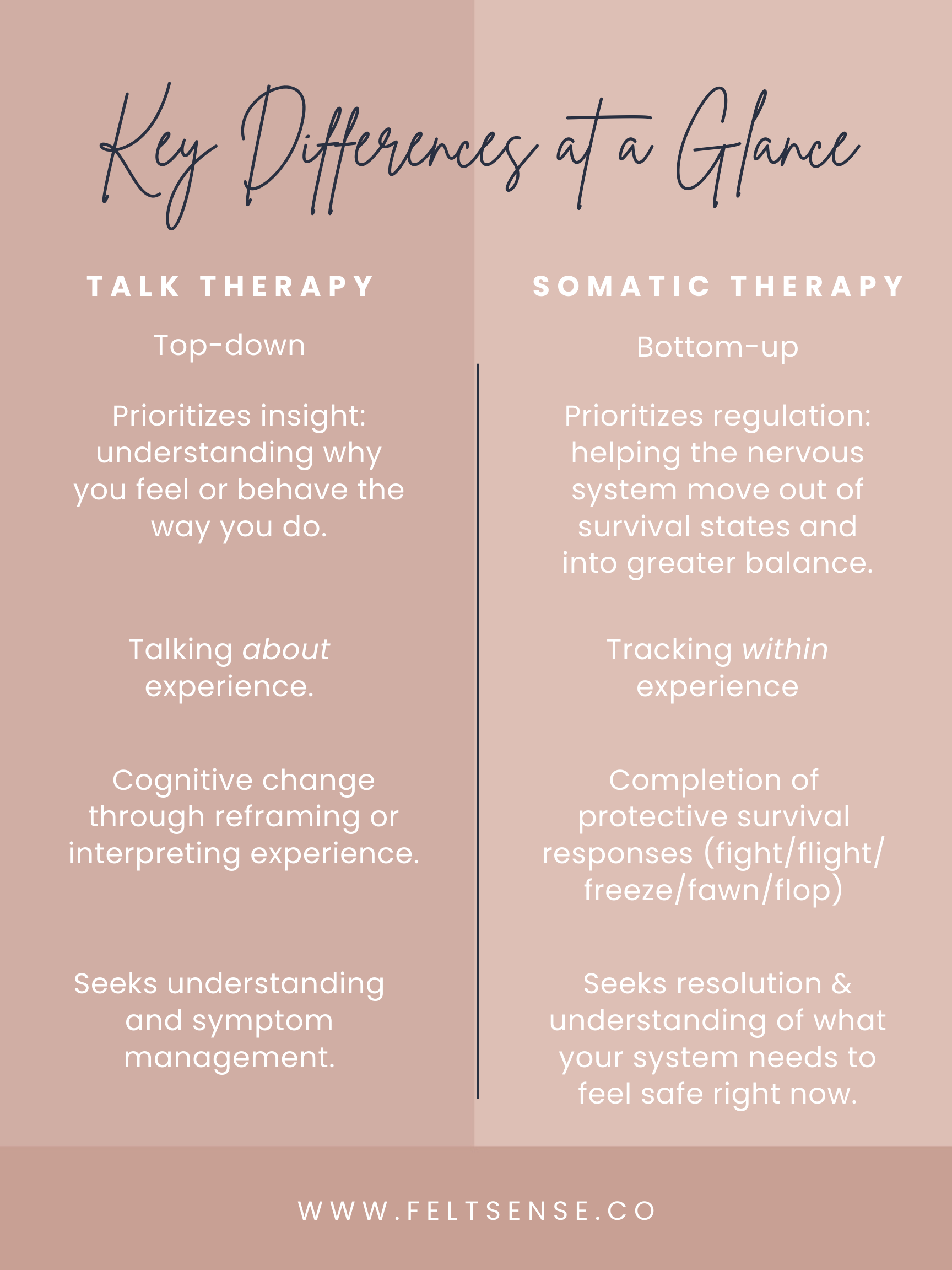
How to Know Which Approach Might Be Right for You
Talk therapy may be a good fit if:
You want insight into patterns or relationships
You feel emotionally regulated most of the time
Understanding tends to lead to change for you
Somatic therapy may be helpful if:
Your body reacts as if danger is present, even when you know you’re safe
You experience chronic anxiety, shutdown, or overwhelm
Talking about the past feels destabilizing
You feel disconnected from your body or emotions
You struggle with boundaries, people-pleasing, or over-giving
Insight hasn’t led to the change you’re seeking
In practice, these approaches aren’t mutually exclusive. Somatic therapy is not a quick fix or a single technique. Rather, it’s a gradual, personalized process that meets your nervous system where it is. While the body is central to the work, elements of traditional talk therapy are often woven in as needed, depending on your history, capacity, and goals. Healing from chronic stress or trauma takes time, and effective therapy is individualized, adapting as you do.
What Somatic Therapy Looks Like in Practice
In somatic trauma therapy, we begin by establishing safety and stability. From there, we explore activation at a pace your nervous system can tolerate- often, slower is better. The work is collaborative, choice-based, and continually oriented toward what feels supportive and grounding.
We might experiment with movement, postures, or breathing practices. You’ll often be invited to pause and notice what’s feeling alive in your body now as you’re sharing your story. We may explore noticing and allowing impulses, for example to say “No!", to push away, or to make a grimace with your face. If ever things start to feel overwhelming, we always re-orient towards safety and come back to what feels resourceful.
It’s possible to find ease and safety within.
Feeling stuck in therapy doesn’t mean you’ve failed or that healing isn’t possible. Often, it simply means your nervous system needs a different kind of support. Somatic therapy and Somatic Experiencing® offer a gentle, paced way to build safety, resilience, and lasting change. If this resonates, I’d be happy to discover if working together could be a good fit!
Book a free, no-pressure consultation.
